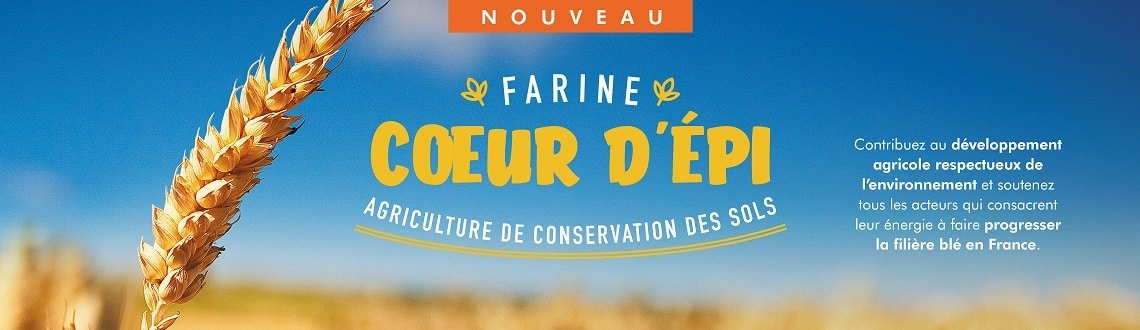
As a member of the Vivescia cooperative, which represents 10,500 farmers, Grands Moulins de Paris is strengthening its commitment to greater responsibility by jointly developing a 100% group-owned supply chain basedon soil conservation farming practices. This approach combines high-quality, high-volume production with respect for the soil and its biodiversity, while ensuring greater recognition for farmers’ practices. The first flour product from this supply chain will be available in eastern France.
Conservation Agriculture to Protect the Environment
In France, according to INRA, approximately 4% of farmers have adoptedconservation agriculture. At Vivescia, more than 350 farmers have joined the VIVESCIAgroscol club. For over 10 years, the cooperative has developed expertise in this method, which is crucial for soil biodiversity and the fight against global warming. A set of farming practices that promote plant diversity and carbon storage in the soil.
Conservation agriculture is based on a set of agricultural techniques that promote biodiversity.
This type of agriculture employs techniques that help retain natural organic matter in the soil: soil conservation, maintaining permanent ground cover with cover crops, and extending the crop rotation cycle to include a greater variety of crops. In this way, the soil works on its own and regains its original nourishing function.
We constantly challenge ourselves to ensure we provide the best for our customers. Grands Moulins de Paris is proud to be owned by its member farmers.
The Four Core Principles of Cœur d’Epi
• Grow wheat in northeastern France, less than 100 km from the mill in Brienne-le-Château*, where it is ground into flour;
• Use a farming system that places soil at the heart of its agricultural practices and helps combat climate change (carbon sequestration): treat soil as a living environment that must be protected while maintaining high-quality, consistent, and productive yields;
• Provide long-term support to cooperative farmers to help them create value;
• Promote agricultural practices that support animal and plant biodiversity in the soil and in the fields: minimizing tillage, using companion plants, maintaining permanent ground cover, and limiting the use of inputs.
These values are central to our concerns, as well as to those of farmers, our customers, and consumers.
According tothe 2020Kantar Food 360 study, 77% of consumers are interested in innovations in food products that are environmentally friendly and help conserve natural resources. 68% prefer food products made in their region or nearby.
The first Cœur d’Epi product, bringing us closer to the consumer
Grands Moulins de Paris is committed to natural ingredients and responsible food production. The ear of wheat symbolizes the entire supply chain, from the field to the finished product. The first Cœur d’Epi flour is made from French T65 wheat grown using soil conservation farming methods. Grands Moulins de Paris selects its wheat from the finest terroirs in France. The first Cœur d’Epi product is made with wheat from northeastern France, the harvest region of the Vivescia cooperative.
They are then milled at the Brienne-le-Château mill. These Cœur d’Epi products will be available regionally, in order to minimize the environmental impact and strengthen ties among the industry’s stakeholders: farmers, millers, artisan bakers, and consumers.
This initiative will gradually be expanded to the rest of France in order to offer our customers high-quality products that respect all stakeholders in the industry.
Cœur d’Epi: A Guided Program
The production of Cœur d’Epi flour is strictly regulated by various standards and specifications.
Compliance with the NFV30 standard:
• Reducing nitrogen and phosphorus leaching;
• Site selection aimed at ensuring a soil structure conducive to crop root development and soil biological activity;
• Take a rational approach to crop protection;
• Control methods tailored to each pest;
• Preventive measures against voles and field mice.
Compliance with Vivescia’s Conservation Agriculture Specifications:
• Avoid deep tillage below 10 cm;
• 100% coverage of intercrops;
• Plant companion crops with winter rapeseed;
• Use decision-making tools (decision trees, notes, etc.);
• Use certified seeds.
Vivescia has also signed a three-year contract with cooperative farmers.
To learn more about conservation agriculture: https://www.youtube.com/watch?v=vFRB-L5NEZQ
To read testimonials from farmers involved in the industry: https://entreprise.grandsmoulinsdeparis.com/actualites/entreprise/coeur-epi-agriculture-conservation-sols-interview-agriculteurs-filiere/
*For the first model in the line