

Climate and its impact on wheat
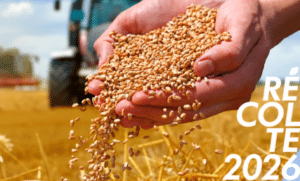
In France, the area planted with soft wheat for the 2023 harvest is estimated at 4.77 million hectares (according to data from the Ministry of Agriculture and Food Sovereignty), representing a slight increase compared to last year (+2%) and remaining stable compared to the five-year average.
Thanks to mild autumn weather, the planting took place in mid-October without any issues.
The end of winter and the start of spring were relatively rainy, which was favorable for growing conditions. However, June saw widespread drought, which reduced yield potential (primarily in the production areas south of the Loire). Finally, the rains that began in late July also negatively impacted yields and quality in areas that had not yet been harvested.
Overall, the French wheat harvest was once again atypical. It was early in the production areas south of the Loire and late in the northern and northwestern departments due to an excessively rainy summer.
In terms of both yield and quality, this harvest has therefore varied depending on the harvest dates, soil types, and terroirs.
The situation is the same in other European countries. Due to a severe drought during the spring, the Spanish harvest is low (3 million tons vs. 5.1 million tons last year). In Eastern Europe (Romania, Bulgaria, etc.), harvests were decent, exceeding the five-year average. In Germany and Northern European countries, the grain harvest was still underway at the end of August due to incessant rains, which degraded both yields and quality standards.
Among other major wheat exporters, the 2023 harvest is expected to be average: Russian production is below last year’s record levels (85 million metric tons vs. 100 million in 2022), and dry spring conditions are limiting yield potential in Canada and the United States.
As we do every year, all our teams are hard at work in our mills, selecting and blending batches of wheat to create blends that guarantee consistency and uniformity.
Production and Yield Estimates (Soft Wheat)
• French production: 35.1 MT vs. 33.7 MT last year vs. a 5-year average of 34.2 MT.
• French yield: 7.35 tons per hectare vs. 7.17 tons per hectare last year vs. a 5-year average of 7.19 tons per hectare.
• EU-27 yield: +/-5.7 t/ha vs. 5.7 t/ha last year vs. a 5-year average of 5.75 t/ha.

• Protein content: average > 11%
• Specific gravity: > 76 kg/hl
• Hagberg: > 220 seconds

Kneading:
• → Same hydration as R22.
• → Same smoothing as R22.
Preparation:
• → Similar fermentation activity this year.
• → No difference in how it holds up when placed in the oven.
Forming:
• ↑ Excess elasticity during forming this year.
• → Stretchability unchanged.
• → Elongation: no change compared to R22
• → Stickiness: same dough-like texture as R22.
Finished product:
• → Beautiful finished products with very good volume.
• ↑ Beautiful yellow crumb color.
Our tips:
Baguettes: Our millers refine our wheat blends every year to offer you consistent, top-quality results.
The dough has a different profile compared to last year: it’s more elastic. Autolysis is recommended this year.
The finished products look great, with beautiful crumb colors and well-developed slashes.
Miller’s blends: The formulas for our miller’s mixes are constantly adapted to harvest conditions to ensure consistent, high-quality results. No adjustments on your part are necessary.
Baking improvers: SECUR’TOLERANCE combined with autolysis is recommended this year.
SECUR’DETENTE is recommended for processes without autolysis or highly mechanized operations.
Kneading:
• → Consistent hydration vs. R22.
• ↓ Lack of smoothing this year.
Preparation:
• ↓ Lower fermentation activity this year.
• → No difference in oven performance.
Shaping:
• ↑ Excess elasticity during kneading and shaping.
• ↓ Lack of elasticity this year.
• → Dough texture similar to R22.
Finished product:
• ↓ Properly baked finished products, small batches.
• → Beautiful creamy crumb color.
Our tips:
Baguettes: Our millers refine our wheat blends every year to offer you optimal and consistent quality.
This year, there are no changes to the hydration levels. However, the doughs have a different profile compared to last year: they glide less smoothly, and the dough strands are shorter and more elastic. Autolysis and/or an increase in kneading time are strongly recommended.
The finished products are satisfactory.
Milling blends: The formulas for our milling blends are constantly adapted to harvest conditions to ensure consistent, high-quality results. No adjustments on your part are necessary.
Improver agents: SECUR’DETENTE yields better results this year, but both improver agents—SECUR’DETENTE and SECUR’TOLERANCE—can be used and will produce excellent products.
Kneading:
• → Target hydration.
• ↓ Less effective smoothing compared to R22.
Preparation:
• → Fermentation activity similar to that observed last year.
• → Holds up well when baked.
Handling:
• ↑ Increased elasticity during handling this year.
• → Stretchability unchanged.
• → Dough texture identical to last year.
Finished product:
• → Good volume and attractive finished products. Less blade cut development due to long proofing times.
• ↑ Increased coloration of the crumb.
Our tips:
Baguettes: Our millers refine our wheat blends every year to offer you consistent, top-quality results. The hydration level is spot on. The dough has a different texture compared to last year: it’s more elastic and less smooth. Autolysis is recommended this year. Prioritize baking the dough while it is still young. The finished products are attractive, with beautiful crumb colors.
Milling blends: The formulations of our milling blends are constantly adapted to harvest conditions to ensure consistent, high-quality results. No adjustments on your part are necessary
. Baking improvers: SECUR’TOLERANCE combined with autolysis yields good results this year.
SECUR’DETENTE remains recommended for processes without autolysis or highly mechanized processes.
Kneading:
• → Water content consistent at R22.
• ↓ Slightly less smooth this year.
Preparation:
• → Fermentation activity similar to R22.
• ↑ Good oven stability.
Forming:
• ↑ Excess elasticity during forming.
• ↓ Dough is slightly tougher this year.
• → No sticking.
Finished product:
• → Well-formed finished products with attractive scoring.
• ↑ Beautiful yellow crumb color.
Our tips:
Baguettes: Our millers refine our wheat blends every year to offer you consistent, top-quality results.
The dough has a different texture compared to last year: it is more elastic and resilient. Autolysis is recommended this year. The finished products are beautiful, with attractive crumb colors and well-defined slashes.
Miller’s blends: The formulations of our miller’s mixes are constantly adapted to harvest conditions to ensure consistent, high-quality results. No adjustments on your part are necessary.
Improver agents: SECUR’DETENTE yields better results this year, but both improver agents—SECUR’DETENTE
and SECUR’TOLERANCE—can be used and will produce excellent products.
Kneading:
• → Similar hydration to R22.
• ↓ Less effective smoothing compared to R22.
Racking:
• → Normal fermentation activity.
• → Good stability during bottling this year.
Shaping:
• ↑ Excess elasticity during shaping.
• ↓ Less stretch this year.
• ↓ Lack of elongation this year. • → Firmness unchanged.
• → Dough texture identical to last year.
Finished product:
• ↑ Beautiful finished products. Good volume.
• ↑ Creamy crumb color.
Our tips:
Baguettes: Our millers refine our wheat blends every year to offer you optimal and consistent quality. The dough has a different texture compared to last year: it is less smooth and more
elastic. Autolysis and/or an increase in kneading time are recommended this year. The finished products are beautiful, with attractive crumb colors and well-developed slashes.
Milling blends: The formulations of our milling blends are constantly adapted to harvest conditions to ensure consistent, high-quality results. No adjustments on your part are necessary.
Improver agents: SECUR’TOLERANCE combined with autolysis yields better results this year.
SECUR’DETENTE is recommended for highly mechanized processes.