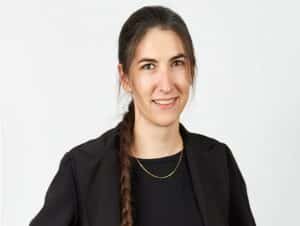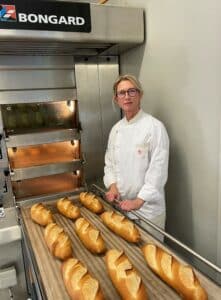
Upstream Supply is an essential link in ensuring we can deliver effectively to our customers. Learn about the roles of the teams within this division through a profile of Aline CHOMILIER, Director of Upstream Supply, who has been with Grands Moulins de Paris for eight years.
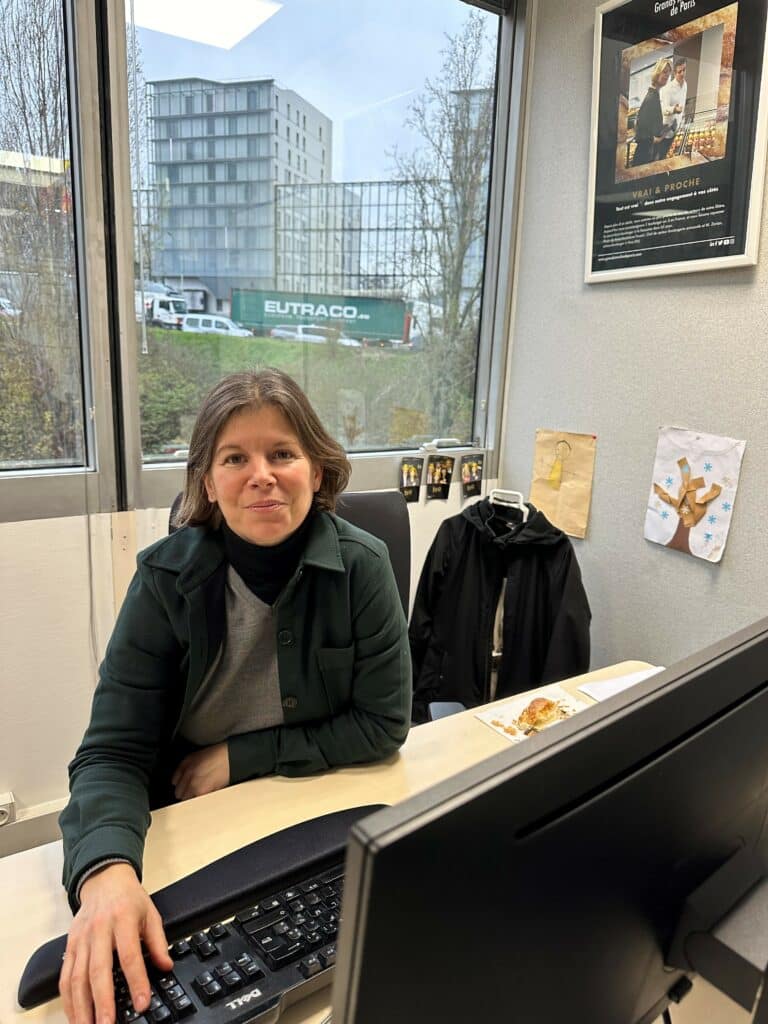
Hi Aline, could you introduce yourself and tell us about your background?
Hello! My name is Aline Chomilier. I’m 47 years old and the mother of three boys aged 9 to 16. I’m half Breton and half Auvergnat, and I’ve lived in Paris’s12th arrondissement for 20 years and work in Ivry. Many of my colleagues know that I love riding my bike to the office!
With a degree in agricultural engineering, I joined the food company “MARIE” in 2000, which marked my first truly significant professional experience.
I stayed there for 10 years, moving from the position of production planner for Marie Frais to that of planning manager, gaining experience in management control, before returning to a management role
In 2011, I switched industries when I joined UNIVAR, a global distributor of chemical products and ingredients, as the inventory and procurement manager. In that role, I managed a team of 20 people responsible for product procurement, some of which was sourced internationally.
In 2016, I joined Grands Moulins de Paris as Supply Planning Manager to return to the food production sector. Since then, I’ve had the opportunity to see my role evolve, and I am now Director of Upstream Supply.
And what led you to a career in supply chain management?
Good question!
I chose to study agronomy because I’m fascinated by anything related to living things, but when I graduated, I didn’t know much more about the names of plants than I did before… *laughs*
I ended up getting into the food industry and production somewhat by chance through an internship, and I really enjoyed it. Ultimately, it was my professional experience that led me to supply chain management, which suits my proactive, organized, and logical nature.
By the way, could you explain what “Upstream Supply” means at Grands Moulins de Paris?
Our role is to provide the right product, in the right place, at the right time, in the right quantity and quality—all at the lowest possible cost.
Our core business areas are "sales forecasting," "production planning," and the "procurement and distribution" of finished products to our customer shipping warehouses.
We focus on data analysis and information sharing. We specify the quantities to be produced and moved so that the factories and the downstream supply chain (i.e., logistics) can “physically” fulfill the requirements for production, preparation, or transport.
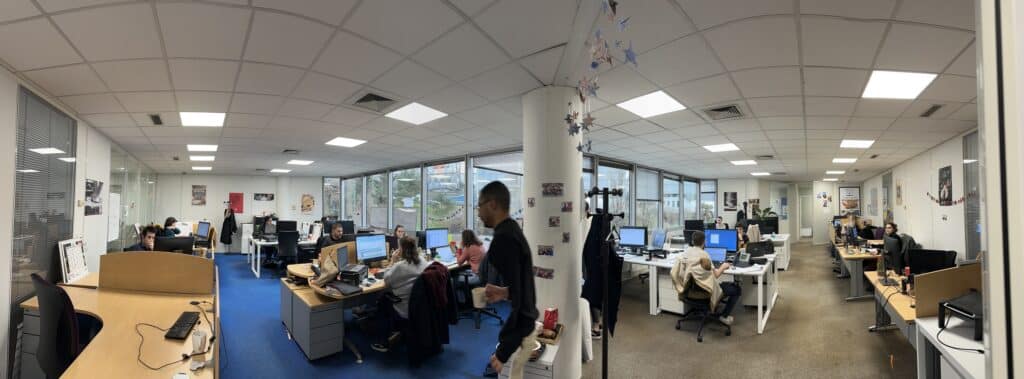
We therefore work closely with both our headquarters teams and our field teams in sales, production, and logistics. We also maintain direct contact with some of our clients, particularly those in the supermarket and big-box retail sectors.
The team has grown since I joined. We started with 10 people, and today my team has nearly 25 members.
The management team consists of a "Tools & Projects" division, which oversees the tools used by our business units (Dynasys, Tableau, SAP, etc.), and three "Operations" divisions that manage our "flagship projects" by product category:
· A "Frozen Foods" section for "Recettes de mon Moulin" brand frozen products
· A "GMS" division for "Francine" brand flours and mixes
· A "Pulv" division specializing in flours and mixes for bakers, food manufacturers, major accounts, and supermarket bakeries in France, as well as for international customers.
Recently, two additional departments have been assigned to the division:
· Sales administration for supermarkets, including order management and penalty handling, tasks carried out by the “Supermarket Operations Division”
· Master Data Management (MDM) for products and suppliers in SAP. The mission of the “MDM team” is to create, modify, and ensure the consistency of all this data, which feeds into all of Grands Moulins de Paris’s IT systems.
Are there one or more key qualities needed to successfully carry out upstream supply chain tasks? And what aspects do you like best?
In my view, it is essential to have a strong aptitude for hands-on work, to be flexible and pragmatic, especially when it comes to making decisions “without having all the facts at hand.”
Our work requires strong analytical skills, logical thinking, attention to detail, good interpersonal skills, and a healthy dose of humility. Indeed, we are sometimes called upon to take responsibility for our own mistakes and those of others.
What immediately appealed to me was the cross-functional nature of upstream supply chain management, which involves daily interactions with various departments such as production, sales, marketing, management control, IT, procurement, and the rest of the supply chain.
As Director of Upstream Supply, my role is to lead my team and work on our processes to adapt our operations with a focus on continuous improvement.
Leading involves recruiting, training, developing, and motivating teams; to that end, I work closely with Human Resources on a daily basis.
I really enjoy thinking through and implementing or adapting our processes because I love creating and organizing, and I also enjoy working on planning the structure of our teams.
At times, I get involved in day-to-day operations, especially when we’re in “crisis mode” and need to quickly find solutions to put out the fire, and I still find that incredibly exciting.
What are the complexities of the upstream supply function in the milling industry?
First, the minimum shelf life of the flour (and frozen products) adds complexity to inventory management, as is the case with many food products in general.
Second, our complexity stems from our management of multiple markets and technologies. We must address the specific needs, characteristics, and requirements of each market (Export, Supermarkets, Food Service, Industrial, Key Accounts) as well as those of each technology (frozen foods, powdered products, point-of-sale displays, bagged goods).
Like any upstream supply chain, we must also navigate the difficult dilemma between:
-
- – Improve our delivery service rate to our customers (because bakers have limited storage space and can’t afford to be out of bread or croissants when they open in the morning, because the supermarket chain fines us if we don’t deliver, because manufacturers can’t shut down their production lines if deliveries are missed…)
And
-
- – Manage our inventory levels, as we have limited storage space (both internally and externally), and inventory is costly (storage costs + tied-up capital).
… all while facing constant uncertainty about exactly how high our sales will be, and the risk of production issues.
And finally: You’ve been with Grands Moulins de Paris for eight years now, and you seem to be thriving there. In a few words, how would you describe GMP?
If I were to play around with the acronym “GMP” as I usually do, I would say:
· “G” stands for Group/Family because, just like in a family, we talk things out when a conflict arises. Plus, we’re truly united and all share very human values.
· “M” stands for “Meunier” because milling is, above all, our core business, and each mill is truly unique, with a strong focus on the employees who work there.
· “P” stands for “Projection” because Grands Moulins de Paris is a company that knows how to look ahead, as demonstrated by the recent launch of the Marketplace and SAP, as well as all the initiatives being implemented across our sites in the areas of occupational health and safety. I think this really captures our spirit of boldness.
That’s why I’m so happy and proud to work for Grands Moulins de Paris!
Thank you to Aline for sharing your experiences and for your contribution to our series of profiles on women in the milling industry. See you soon for the next #CollectivelyCommitted profile! 🚀🫶