VIVESCIA AND GRANDS MOULINS DE PARIS ARE HOSTING UNESCO TODAY AND CELEBRATE THE BAGUETTE!
In late March, Culture Minister Roselyne Bachelot announced that France had selected the baguette as its nomination for inclusion on UNESCO’s List of Intangible Cultural Heritage (ICH). As part of the review of this nomination and during the Châlons-en-Champagne Fair, UNESCO ambassadors were invited to visit the Marne region, a leading producer of wheat.
In collaboration with the VIVESCIA Group, its cooperative, and its milling company Grands Moulins de Paris, as well as Dominique Anract, President of the National Confederation of French Bakers and Pastry Chefs (CNBPF), who initiated the bid, a comprehensive program has been launched to explore the baguette and all the associated skills, across every link in the chain… from the wheat fields to the baker!
To be eligible for inclusion on UNESCO’s Intangible Cultural Heritage list, the proposed practices or skills must, among other things, be recognized as part of a community’s cultural heritage, passed down from generation to generation, and provide a sense of identity and continuity. As an inseparable symbol of France and an integral part of our daily lives, the baguette seems like the perfect candidate!
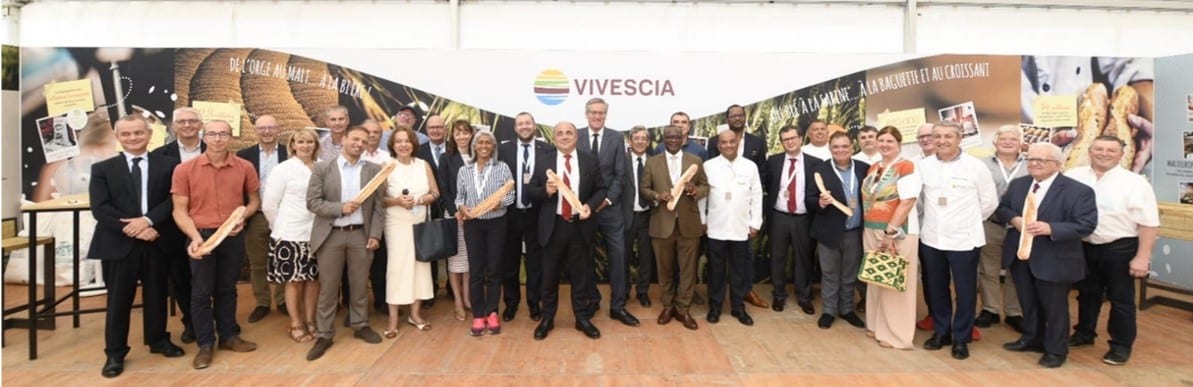
On Tuesday, September 7, the UNESCO delegation—comprising about ten international ambassadors, all Permanent Delegates to the Organization, including Her Excellency Véronique Roger-Lacan representing France—was received by the VIVESCIA Group—the Cooperative and its milling company, Grands Moulins de Paris. “It is an honor to contribute to this remarkable ambition to have the baguette recognized as part of UNESCO’s Intangible Cultural Heritage. It is also a tribute to all the men and women in this region who cultivate excellence, from wheat seeds to the finished baguette. “Expertise, passion, tradition, and taste—that’s what the French baguette is all about, and it’s unique!” enthuses Christoph Büren, President of the VIVESCIA Cooperative Group.
This morning, the goal was to showcase to the UNESCO delegation the full range of expertise that makes the baguette a unique product, primarily through meetings and discussions with all stakeholders in the industry, right in the heart of the local communities. Thus, after observing the production of baguettes and enjoying a tasting at a Reims-based bakery, Mr. Nabil Sbai’s “La Case à Pain,” the delegation visited the Reims mill to discover the expertise of Grands Moulins de Paris, a century-old milling company. Late in the morning, the delegation visited the “VIVESCIA Village” at the Châlons-en-Champagne Fair (France’ssecond-largest agricultural event) to meet with farmers from the VIVESCIA Cooperative, which now has 10,500 members.
“While making a baguette requires very few ingredients, it is the selection of these raw materials and the expertise of a team of passionate men and women that make it a product of excellence,” emphasizes Pierre Garcia, CEO of Grands Moulins de Paris.“We are proud to be part of this human chain and to be able to contribute every day to promoting and passing on this symbol of our French heritage, which is envied around the world, whether through our customers or through the Paris School of Baking and Pastry.”
Several prominent figures were also in attendance to support this bid, including Guillaume Gomez, the President’s personal representative for promoting French cuisine in France and around the world.
Just as patience is required of the baker to work the dough, of the miller to select and grind the grain, and of the farmer to watch his crop grow and harvest it, patience will also be needed while awaiting UNESCO’s final decision, which is expected in the fall of 2022.