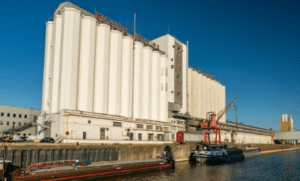
At Grands Moulins de Paris, flour milling is a centuries-old craft that we carry on in our eight regional mills and our flour blending plant! Today, we’re opening the doors to our mill in Brienne-le-Château, where Sébastien Leclerc will welcome you for a guided tour. Several steps are required to make flour from wheat grains, and here’s how the process works.
Wheat Inspection
The mill’s raw material is high-quality milling wheat, carefully selected and sourced from within 125 km of the mill. This wheat is transported to the mill by truck, train, or barge. Once the wheat arrives, its quality must be verified.
To do this, samples are taken and various tests are conducted. The purpose of these tests is to verify that the wheat meets Grands Moulins de Paris’s standards and can therefore be used to produce flour. Once the wheat has been deemed compliant, it moves on to the next stage: blending and cleaning.
Wheat blending and cleaning
Each flour in our catalog has its own unique characteristics, which is why we offer different flour blends. Millers therefore combine several varieties of wheat to create a precise blend that produces a flour tailored to our customers’ needs. Once the wheat has been blended, a cleaning process is required to remove any impurities, straw, or stones that may have found their way into the grains.
They then add water to make the starchy endosperm more crumbly and soften the husks, which will yield the bran. The mixture must be left to rest for about 24 hours after the water is added to ensure even distribution within the grain.
From wheat to flour
Milling involves crushing wheat grains to separate the husk from the starchy endosperm. As the name suggests, flour is made from the starchy endosperm.
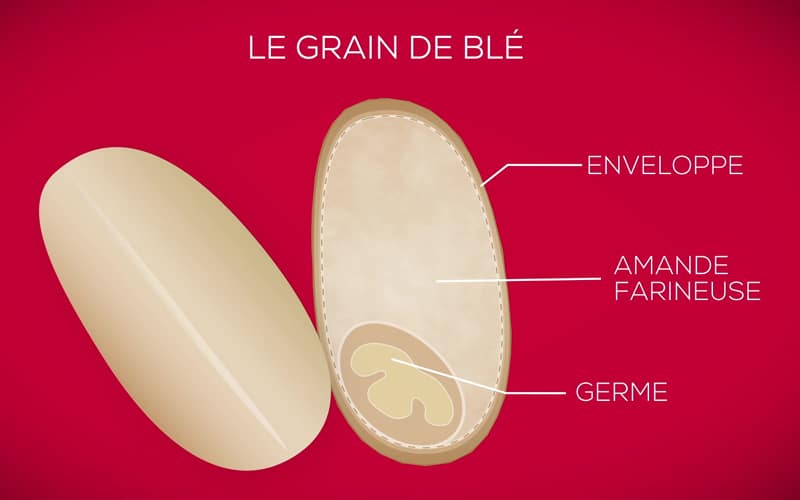
To extract as much flour as possible while ensuring its purity and fineness, a series of grinding and sifting steps must be carried out. The wheat is crushed by rollers. The flour is then obtained after sifting using plansichters.
The wheat grains pass through five fluted roller mills, each with progressively finer grooves that allow for finer grinding. At the end of these milling stages, we obtain coarse bran and fine bran.
There are also smooth rollers: the beaters and converters, which grind the semolina—large almond particles—into flour. At the end of these steps, we obtain the re-ground product.
After each stage of grinding, beating, and converting, followed by sifting, we obtain flour.
Plan Sichters, or rotary sifters, are essential machines for producing high-quality flour. They determine the purity and fineness of the flour. These machines consist of stacked screens that allow for the classification of particles by size of the products exiting the rollers. This step thus enables the extraction of flour. The other products are directed to the appropriate rollers to continue the extraction process.
Quality control of the flour produced
The final step in flour production before packaging is quality control. Here, we get our hands dirty to make sure the flour produces good bread. We check its appearance, ensure it mixes properly, and finally verify that the bread, pastries, and baked goods come out of the oven perfectly!
Flour milling is a craft that Grands Moulins de Paris is proud to pass on and refine each year through our strong commitment. These processes, combined with the passion of our employees, are what have enabled us to provide bakers and pastry chefs with a raw ingredient that has enhanced their talent for 100 years!