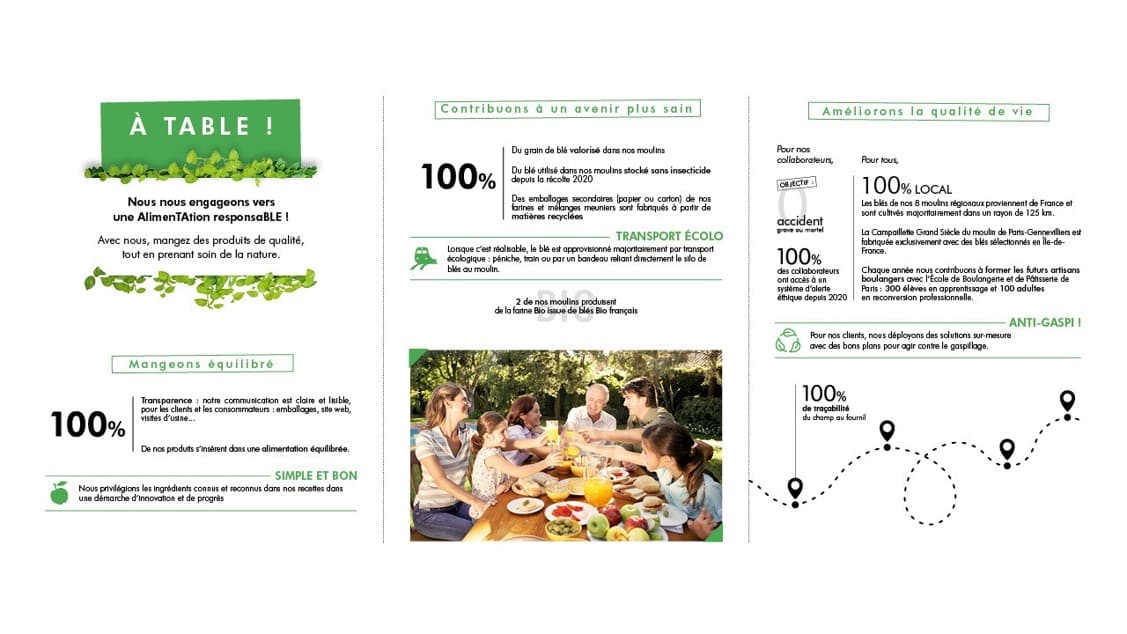
“A TABLE”: This is the name of Grands Moulins de Paris’s CSR initiative, launched in 2019 to mark its centennial. With an eye toward the future, this initiative is based on three strong commitments designed to meet the expectations of French consumers and guide Grands Moulins de Paris’s actions towardresponsiblefood production.
One of the three pillars— “Let’s contribute to a healthier future” —is to make agricultural production more environmentally friendly. Today, the first steps have been successfully taken, and two goals have already been achieved:
• 100% of the wheat grains used in the mills are stored without insecticides.
• Two mills produce organic flour made from French organic wheat.
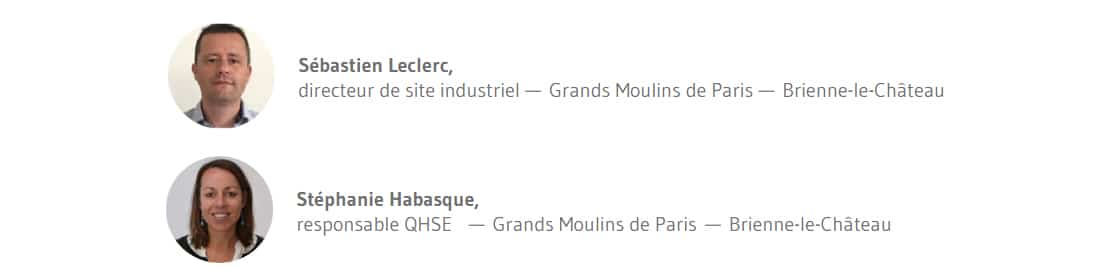
An interview with Sébastien Leclerc, industrial site manager, and Stéphanie Habasque, QHSE manager, wholaunched these two initiatives at the pilot mill in Brienne-le-Château in the Aube department.
No insecticides in storage by the end of 2020. Goal achieved at all mills!
Why did you decide to switch to SIS? How did you implement the process?
For Grands Moulins de Paris, switching to wheat free of storage insecticides (SIS) was a prerequisite, as it is primarily residues of storage insecticides that we find in our flours. This approach therefore allows us, first and foremost, to improve the food safety of our flours and meet our customers’ expectations.
The first SIS wheat harvest was delivered to the Brienne mill in 2018. We then rolled out the program over the next three years across our eight mills, and we were ready for the 2020 harvest.
To achieve this, we undertook significant preparatory work with our wheat suppliers. At our mills, we do not apply any treatments to stored grain. The success of this initiative therefore depended largely on our ability to convince the storage facilities we work with to switch to a “zero storage insecticide” approach.
Some were already doing so, while others have taken steps to switch all or part of their silos to zero storage insecticides.
Today, all the wheat purchased and delivered to our mills is SIS-certified. We have achieved our goal, and we are very pleased with the results, which also involve our suppliers in this more responsible production approach and give us access to new supply chains and markets. We are currently in the process of being listed by Nestlé, which is becoming a new client of GMP Brienne for the “Préférence” line.
Have you stepped up quality controls at the mills?
Yes. We have implemented a year-long monitoring plan that includes new checks:
• increased testing of the first three shipments from the new silos that supply us with SIS wheat,
• followed by a monthly IS residue analysis for each storage facility that supplies us with SIS wheat.
The main concern was that we might find more insects in the wheat. But we aren’t seeing any more rejected shipments than before. And we’re doing everything we can to prevent this problem.
For example, at VIVESCIA, some of the cooperative’s silos have been equipped with cooling units (large air conditioners) and ventilation systems to stabilize the temperature of the grain and prevent the development of insects in the storage cells.
And in most of our mills, we use heat technology (harmless to humans) that allows us to treat the mill and kill all types of insects within 36 hours.
We have also strengthened our local and internal cleaning protocols for the processing systems to limit insect infestations.
The Brienne Mill was also the first to produce organic flour.
What changes and/or challenges did this new production involve?
We obtained our certification in November 2019.
The production of organic wheat flour requires us to rinse our facilities to prevent any cross-contamination between a batch of organic wheat and a batch of non-organic wheat.
Regarding deliveries, we schedule specific days for receiving organic wheat in order to isolate the grains in a silo and perform the rinsing all at once.
Finally, as with SIS wheat, we have a year-round monitoring and traceability plan covering both the wheat delivered and the organic flours produced in our mill.
By the way, who are your main customers for organic flour?
We produce some of the Francine organic flour, which is packaged at the mills in Reims and Gennevilliers (both of which are certified for organic packaging).
Ultimately, we aim to expand our production to serve both the artisanal bakery market and industrial customers. This will require work on selecting wheat varieties and ensuring the consistency of our flours, as demanded by industrial customers. We are therefore proceeding in stages.
So, does this market have promising growth prospects?
Yes, we are seeing strong demand for both 100% French wheat and French organic wheat.
With our mill in Surgères, which was certified as an organic producer in 2020, we now produce 3,000 tons of organic flour sold by GMP.
Our goal is, of course, to support the growth of the organic market, which is no longer just a trend but a genuine lifestyle choice for many French people. To achieve this, we need more organic wheat farmers in the region.