
Grands Moulins de Paris is strengthening its commitment to greater sustainability by jointly developing a 100% group-owned supply chain basedon soil conservation agriculture. This approach combines high-quality, high-volume production with respect for the soil and its biodiversity, while ensuring farmers receive greater recognition for their practices. Read the testimonials of two farmers who have chosen the “Cœur d’Épi” approach.
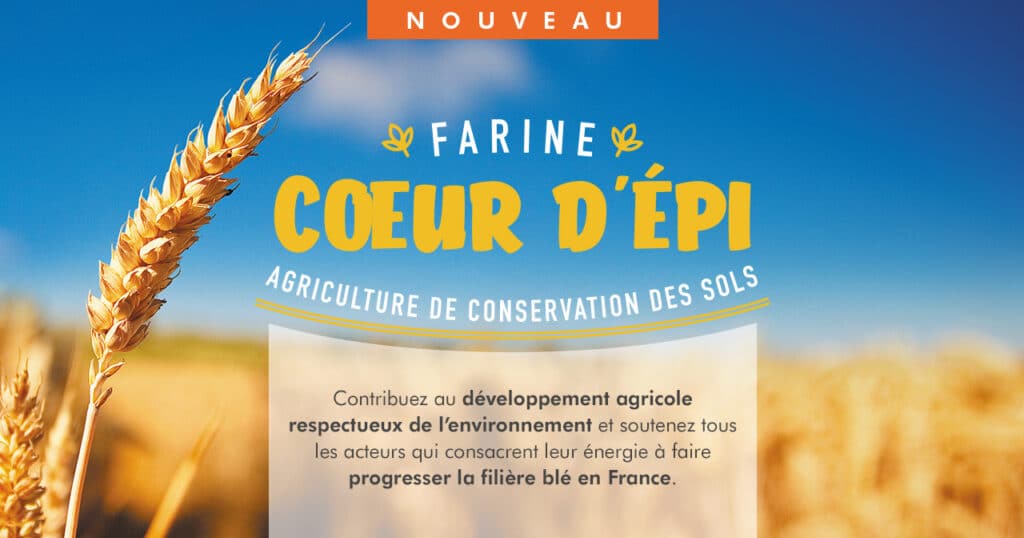
Hélène Barthélémy (35) is based in Fagnières, near Châlons-en-Champagne (Marne). She has been practicing conservation agriculture since she took over her father’s 90-hectare farm in 2019. She is one of the first 10 farmers to join the “Cœur d’Épi” initiative of Les Grands Moulins de Paris.
Why did you join the Cœur d’Epi initiative right from the start?
I’m very passionate about local products, so I’m naturally all for the “Cœur d’épi” supply chain initiative, which processes my wheat at a mill near my home, such as the one in Brienne-le-Château, located in the Aube department. I also keep beehives and sell my honey through direct-to-consumer channels within a few kilometers of the farm. Ever since I took over the farm from my father, I have also adhered to the principles of conservation agriculture, which is another hallmark of this supply chain.
What exactly is conservation agriculture? What are its main farming practices?
Conservation agriculture is based on three pillars: avoiding tillage and plowing, maintaining permanent ground cover, and, finally, long crop rotations and multi-species cropping.
This way, we disturb our soil as little as possible and preserve its biodiversity. In fact, one of my greatest sources of pride is the number of earthworms in my soil! We practice green agriculture because the soil is always covered, even between crops. I rotate crops like rapeseed and faba beans so that the plants benefit each other and enrich the soil with nutrients before planting my wheat crop. Of course, conservation agriculture isn’t always easy because you have to constantly adapt to the weather and the local conditions of each field. For example, I had planned to plant clover on a plot intended for wheat, but we didn’t have enough water, so I had to change my original plan. I’m always learning about agronomy and crop rotation, and that’s what makes this practice so interesting.
How does enrolling in such high-quality programs help you in your career?
I signed a three-year contract with my cooperative, Vivescia , which in turn has a supply chain contract with its milling subsidiary, “Grands Moulins de Paris.” This means that all three of us are committed to producing, collecting, and processing high-quality wheat at a fixed price. It’s reassuring while limiting risks, since I’m committing part—not all—of my production to a supply chain. It’s also a reasonable commitment in terms of price compared to the average of the previous five years. And I can present this commitment as a guarantee—for example, to my bank—which is also reassuring if I need to borrow money to buy equipment.
Francis Martinet (59) has been farming 175 hectares in Erize la Petite (Meuse) since 2012, after working as an auto mechanic and an employee at an agricultural cooperative. Through the Cœur d’Epi contract, he hopes consumers will recognize the quality of his work.
You’re joining the Cœur d’Epi program, which promotes soil conservation practices in agriculture. Could you tell us a little about it?
I signed a three-year contract to dedicate a portion of my wheat each year to the Cœur d’Epi program. It is milled at the Brienne mill, which is 90 km from my fields. I grow all my wheat the same way, using what we callconservation agriculture and no-till farming—meaning I sow directly into the vegetation without plowing. This permanent ground cover helps combat climate change by effectively storing carbon in the soil. To ensure the wheat grows properly, I rely on other plants to do some of the work for me… thanks to their roots, which aerate the soil, and their ability to capture the nitrogen my wheat needs. Of course, I have to be careful that weeds don’t choke my crop or that voles don’t devour my grains…
How can consumers be sure of the quality of your wheat?
The contract we’re signing—between the three of us, my cooperative Vivescia, and its milling subsidiary, Grands Moulins de Paris—is tied to a set of specifications that clearly outline how the wheat must be produced, the specific wheat variety, how it must be stored, and so on. We undergo regular audits to ensure everything is in order. This guarantees my adherence to good agricultural practices. In addition, I have just obtained Level 2 environmental certification for my entire farm, and I will continue this process of improvement to achieve the next level: HVE (High Environmental Value) certification. This is a way to recognize the efforts and expertise I have developed over the past nine years on my farm. You always have to adapt, which is why I’m a member of the Agrosol Club in Vivescia, dedicated to soil conservation agriculture, where we have many discussions with highly specialized technicians and my fellow farmers.
What are you most looking forward to in this new program?
The contract already recognizes the quality of my wheat. By buying bread made from flour produced from my wheat, consumers directly recognize the quality of my work. That’s what matters most to me. We work every day to feed the population. We need our profession to be recognized. To achieve this, farmers must take the time to talk about their practices and how they’ve evolved. Initiatives like this give us that opportunity.